


B.Sc. Nursing
Affiliated to :
Kerala University of Health Sciences
Course Duration : 8 semesters
No. of Seats Available : 100
Aims
- Prepare graduates to assume responsibilities as professional, competent nurses and midwives in providing promotive, preventive, curative and rehabilitative services.
- Prepare nurses who can make independent decisions in nursing situations, protect the rights of and facilitate individuals and groups in pursuit of health, function in the hospital, community nurisng services, and conduct research studies in the area of nursing practice. They are also expected to assume the role of teacher, supervisor, and manager in a clinical / public health setting / school of nursing.
Objectives
On completion of the four year B.Sc Nursing program the graduate will be able to :
- Apply knowledge from physical, biological and behavioral sciences, medical including alternative systems and nursing in providing nursing care to individuals, families and communities.
- Demonstrate understanding of life style and other factors, which affect health of the individuals and groups.
- Providing nursing care based on steps of nursing process in collaboration with individuals and groups.
- Demonstrate critical thinking skill in making decisions in all situations in order to provide quality care.
- Utilize the latest trends and technology in providing health care.
- Provide promotive, preventive and restorative health services in line with the National Health Policies and Programmes.
- Practice within the framework of code of ethics and professional conduct and acceptable standards of practice within the legal boundaries.
- Communicate effectively with individuals and groups, and members of the health team in order to promote effective interpersonal relationships and team work.
- Demonstrate skills in teaching to individuals and groups in clinical/community health settings/ College of Nursing.
- Participate effectively as members of the health team in health care delivery system.
- Demonstrate leadership and managerial skills in clinical/community health settings.
- Conduct need based research studies in various settings and utilize the research findings to improve the quality of care.
- Demonstrate awareness, interest and contribute towards advancement of self and of the profession.
Admission Requirements for B.Sc. Nursing
- The minimum age for admission shall be 17 years on or before 31st December of the year of admission (As per University Norms)
- The minimum educational requirements shall be the passing of : Higher secondary School Certificate (12 years Course), or Senior School Certificate Examination (10 + 2), Pre-Degree Examination (10 + 2) or an equivalent with 12 years schooling from a recognized board or university with Science (Physics, Chemistry, Biology) and English with minimum of 50% aggregate marks. (As per INC norms)
- Candidate shall be medically fit.
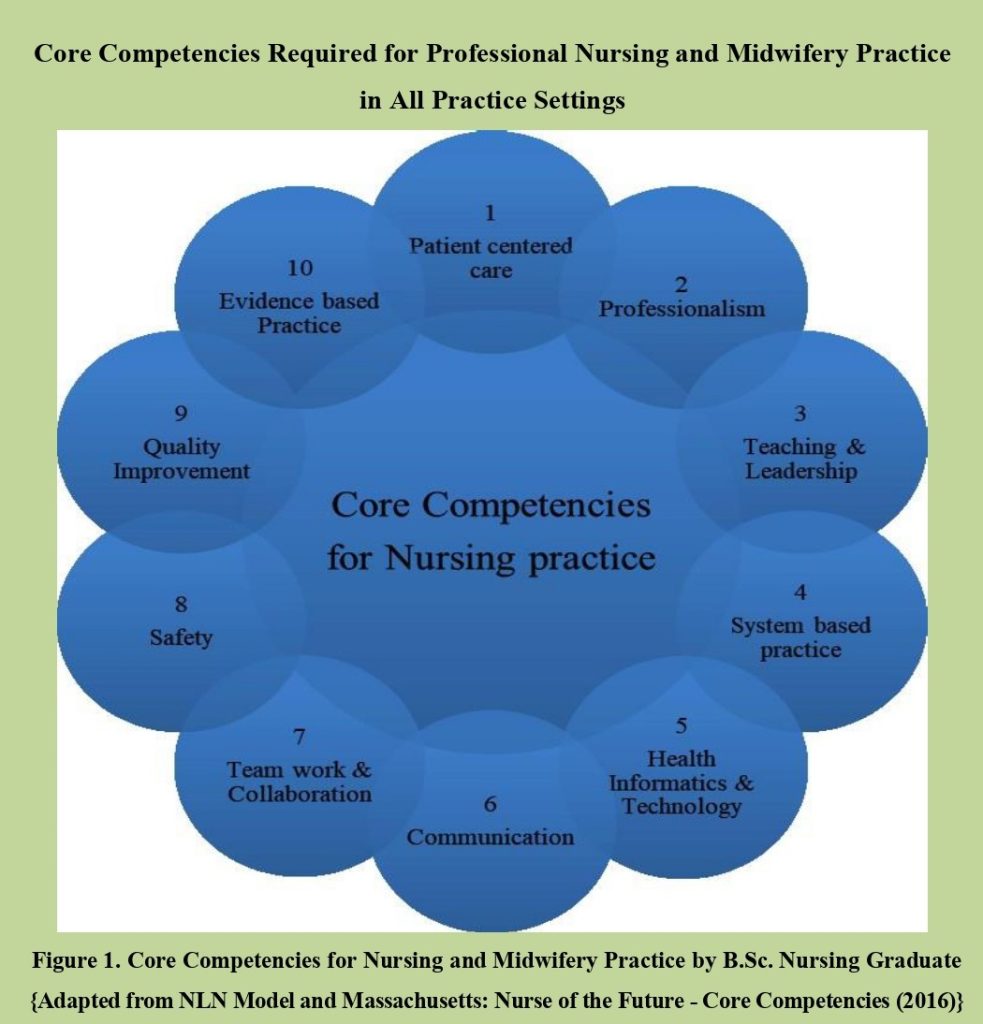
Core Competencies
- Patient centered care: Provide holistic care recognizing individual patient‘s preferences, values and needs, that is compassionate, coordinated, age and culturally appropriate safe and effective care.
- Professionalism: Demonstrate accountability for the delivery of standard-based nursing care as per the Council standards that is consistent with moral, altruistic, legal, ethical, regulatory and humanistic principles.
- Teaching & Leadership: Influence the behavior of individuals and groups within their environment and facilitate establishment of shared goals through teaching and leadership
- System-based practice: Demonstrate awareness and responsiveness to the context of healthcare system and ability to manage resources essential to provide optimal quality of care.
- Health informatics and Technology: Use technology and synthesize information and collaborate to make critical decisions that optimize patient outcomes.
- Communication: Interact effectively with patients, families and colleagues fostering mutual respect and shared decision making to enhance patient satisfaction and health outcomes.
Teamwork and Collaboration: Function effectively within nursing and interdisciplinary teams, fostering open communication, mutual respect, shared decision making, team learning and development.
Safety: Minimize risk of harm to patients and providers through both system effectiveness and individual performance.
Quality improvement: Use data to monitor the outcomes of care processes and utilize improvement methods to design and test changes to continuously improve the quality and safety of healthcare system.
Evidence based practice: Identify, evaluate and use the best current evidence coupled with clinical expertise and consideration of patient‘s preferences, experience and values to make practical decisions.